
Carcassonne
Carcassonne
Hotels
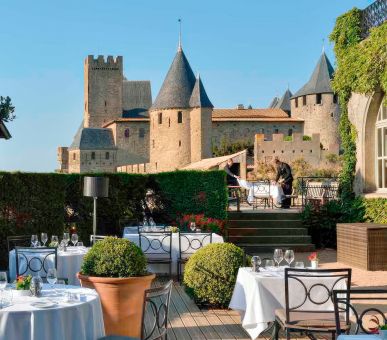



Carcassonne is a true medieval city, nestled on the steep bank of the River Aude. It is located in the Roussillon province in southern France. The fortress is visited by approximately 2 million tourists annually.
The ancient city is surrounded by mighty ramparts, which were once the largest fortified citadel in Europe. Carcassonne boasts 52 towers and two defensive rings, totaling 3 kilometers of fortifications. This quarter of Carcassonne is open to visitors, and around 100 local residents still live here, along with numerous shops and artisan workshops. In this quarter, with its two-thousand-year history of military conflict, you can see sites associated with the Cathar heretical movement of the 11th-13th centuries and the Crusades.
Carcassonne's history dates back to the Gallo-Roman era: in the 6th century, the first fortifications were built – fortified walls protecting the city from enemies. The part of the city within these walls is known as the Upper (Old) Town. In the 12th century, a new Lower Town was founded at the foot of the old fortress, its origins preceded by tragic events. The young Viscount Raymond Roger Trencavel, who ruled Carcassonne at the time, openly supported the heretical Albigensian movement and sheltered them in his city from the pursuing Crusaders. After a 15-day siege by the Crusaders of Stephen de Montfort, the fortress fell. The young Viscount died in captivity at the age of 15, and some of the inhabitants were expelled. It was these same residents who returned to their homeland a few years later, settled on the left bank of the Aude River, and founded the Lower Town. It was later surrounded by a fortified wall, and a hundred years later, another fortified wall was built, along which the boulevard ring runs today. Gradually, the Upper Town fell into neglect, while the Lower Town flourished.
After the signing of the Treaty of the Pyrenees in 1659, the Spanish-French border was moved, the city's fortifications ceased, and it gradually fell into decline. Only in the nineteenth century, at the initiative of the historian and architect Viollet-le-Duc, did restoration work begin.
In Carcassonne, even modern hotels are styled to resemble stone medieval castles, towering over hills or immersed in verdant gardens. Since the early 20th century, it has become a favorite vacation spot for the European elite, drawn here by the southern sun and the leisurely, measured lifestyle.
Carcassonne was the location for many scenes in the Hollywood films "Robin Hood" starring Kevin Costner and "Joan of Arc" directed by Luc Besson. Disney lived in Carcassonne for a long time, and we owe many scenes from Disney cartoons to Carcassonne.
On July 14th, the illuminated citadel hosts a magical event dedicated to the national French holiday, Bastille Day. In the first weeks of August, Carcassonne celebrates a major medieval festival dedicated to the Upper Town itself.
MAIN ATTRACTIONS:
Two of the city's main landmarks are listed as UNESCO World Heritage Sites: the Canal du Midi and the Upper Town with its ramparts.
Currently, the Upper Town is a place of architectural, historical, and cultural significance.
The Count's Castle—a fortress within a fortress—was once owned by the powerful Trancavel family. The castle has a moat, five towers, and wooden fortifications. The castle grounds currently house a magnificent collection of religious artefacts: ancient sculptures, funerary monuments, sarcophagi, steles, and traveling crucifixes.
Cathedral of Saint-Nazaire. Inside the Romanesque-Gothic cathedral is a famous monument stone, which, according to legend, depicts the siege of Carcassonne by the Crusaders.
The Museum of Stone Statues. The collection includes Roman amphorae, Romanesque frescoes, cathedral fragments, some Gothic windows, and medieval stone weapons.
The port on the Canal du Midi accommodates a large number of pleasure boats. Designed by Pierre-Paul Riquet in 1667, the canal and quays of the Aude in Carcassonne are a wonderful place for relaxation and strolling.
The Lower Town is no less interesting. You can reach the Lower Town from the Upper Town by crossing the Pont Vieux. This part of the city boasts houses dating back to the time of Saint Louis, magnificent private mansions, the Palais de Justice, and a beautiful 18th-century fountain on Place Carnot, depicting Neptune. The former Court of Justice building now houses the Museum of Fine Arts, which houses magnificent collections of European paintings.
Worth visiting is the Cathedral of Saint-Michel, built in the Gothic style, with an octagonal bell tower resting on a powerful square base. The magnificent stained-glass windows in the choir and the stunning statue of Our Lady, as well as the paintings and sculptures of the cathedral, are of great artistic value.
Located on the left bank of the River Aude, the Bastide Saint-Louis was built by Saint Louis in 1260 on a quadrangular plan. Today The original checkerboard pattern of the streets and the unified complex, surrounded by a rampart, have been preserved, representing significant architectural value.
For leisurely enjoyment of the sun and water, there's nothing better than the well-equipped beaches of Lake Cavayere, just minutes from the city center.
Golf, canoeing, and horseback riding are available.